July 2026 Trestleboard
The Trestleboard is an official publication of Twin Peaks Lodge No. 32, which is a legally constituted Masonic Lodge operating under charter granted by the Most Worshipful Grand Lodge of Free & Accepted Masons of Utah. The Trestleboard is published for the sole and exclusive use of the members of Twin Peaks Lodge No. 32, and any other use is expressly forbidden. The editor of The Trestleboard is Glen Van Steeter. Submissions of educational articles or other announcements may be sent to the editor at [email protected], and if selected for publication, will be given full attribution. All submissions are subject to the approval of the Worshipful Master of Twin Peaks Lodge No. 32 and the editor of the Trestleboard.
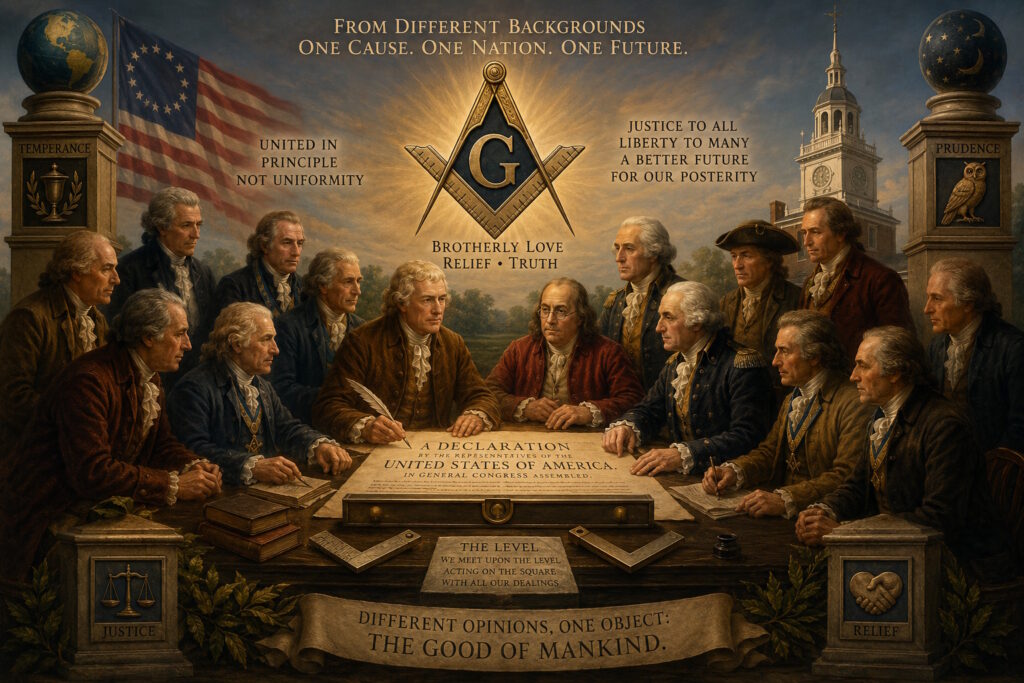
This is a very special edition of our Trestleboard. In edition to the usual articles from the Pedestal Officers, about our upcoming events and other sundries, the educational articles all are in conformity to two Themes: First) How the principles of Freemasonry, as implemented by our Masonic Brethren helped to craft both the Declaration of Independence and the Constitution of the United States of America. Second) How can the principles of Freemasonry, illustrated by the symbols or inculcated through the moral and philosophical teachings of our Craft, be used to lower the temperature of political debate, influence the reduction of performative politics for clicks and views, and to move our factional perspectives away from that which divides us or upon which we disagree, to identifying that which we can commonly agree upon and then using civil discussion instead of inflammatory rhetoric, come to common solutions for the best happiness for the most people.
This, needless to say, is an ambitious goal. And it will be up to you, the reader, to determine the degree of success. It will be equally up to you to determine the magnitude of your agreement or disagreement with the thoughts and ideas expressed in these articles. Remember that around the Freemasonic Altar, you have obligated yourself to use Temperance, Justice, The Level, and the Compasses to restrain your passions and instead to use reasoned, thoughtful and rational counterpoints, ever remembering that a Lodge demands that each brother is equal to all others, neither greater nor lesser.
Let the educational articles be a springboard for thoughtful contemplation and discussion.
Thanks to all the brethren who provided educational articles for this edition of our Trestleboard. Each article has been fully attributed.
— Glen Van Steeter, PM ~ Junior Warden of Twin Peaks Lodge No. 32 and Editor of the Trestleboard
Sickness and Distress
If you are aware of any members whom are in distress, please notify the Lodge Secretary using our Contact page “Email Us” form. Please put “Brother in Sickness and Distress” and then provide details in the “Message” box. This information will be immediately received by multiple members of the Lodge when the “Submit” button is clicked.

Brethren,
June was another outstanding month for Twin Peaks Lodge, and I continue to be encouraged by the momentum we’re building together.
Our June Stated Communication was one of the highlights of the month. We had an incredible turnout, with a dinner table full of prospects and a lodge room filled almost entirely with Twin Peaks members. To me, that’s one of the most encouraging signs in our lodge—our Brothers genuinely want to spend time together. Fellowship has always been the foundation of Masonry, and it is alive and well at Twin Peaks.
Our travels also took us to Amity Lodge, which has transitioned to Saturday morning stated meetings. They were wonderful hosts, treating us to a fantastic breakfast and exceptional hospitality. I also got to enjoy a wonderful Entered Apprentice degree at Bonneville Lodge, and Brought WB Miller and Frankie to their Saturday Breakfast with me. Afterward, we had lunch with Canyon Lodge at their annual picnic, where we were joined by one of our prospects, Chris Cappa.
Back home, we had the privilege of conferring another Entered Apprentice Degree, welcoming Serjio Passerini into the Fraternity. June also kept us busy outside the lodge room. We kicked off the summer at the Scottish Rite picnic, enjoyed another successful Chubbys meetup, and celebrated a tremendous Masons at Work Picnic. Thank you to WB VanSteeter and everyone who attended and helped make it such a fun and successful event.
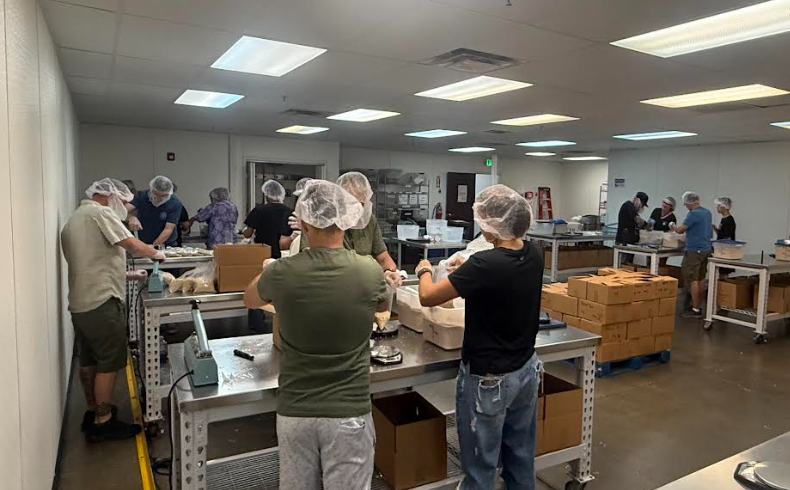
Our commitment to serving others was on full display once again at the Utah Food Bank. With 21 volunteers from our lodge, we accomplished an impressive amount of work in just a couple hours. Every time we show up, Twin Peaks demonstrates what Masonry looks like in action.
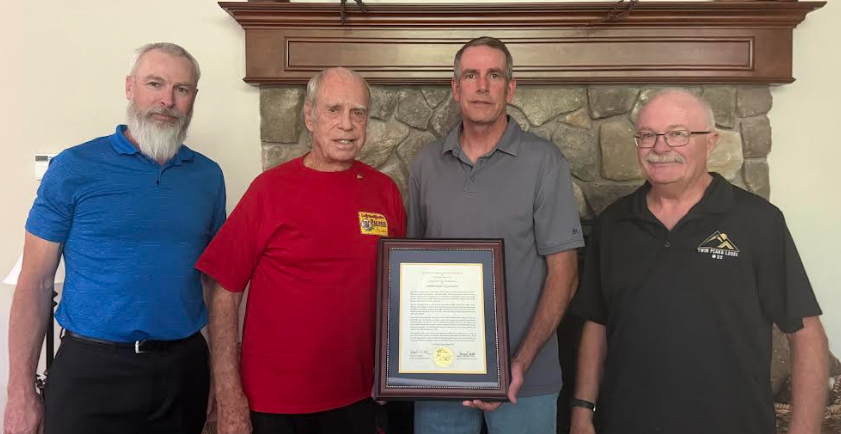
One particularly meaningful moment this month was the opportunity Worshipful Brother Hartman and I had to present Brother James Martin with his 55-Year Masonic Service Award. Visiting him in his home, alongside his son Michael, was a warm and memorable experience, and his gratitude reminded us of the lifelong bonds our fraternity creates.
I also hope everyone had a wonderful Father’s Day, surrounded by family and those who matter most.
Looking ahead, July promises to be another busy month. We expect to read several new petitions at our Stated Communication, and with more candidates entering the pipeline, there will be plenty of opportunities for degree work, fellowship, and service. The future of Twin Peaks Lodge continues to look bright, and I look forward to sharing it with each of you.
Fraternally,
Frank Keller
Worshipful Master

Replace this text.

Happy Fourth of July! This is a most notable holiday, as it is the 250th anniversary of the Declaration of Independence. I know, I know. Nitpickers will remind me that the Declaration was actually ratified by the Second Continental Congress on July 2nd, 1776. However, it was not published nor proclaimed until the Fourth. So just move on. (John Adams would be so disappointed.) I’ll try and keep this short. I will probably fail.
The Masons at Work picnic was a success. We broke even on the food and we made over $1100 on the auction. 62 Masons, spouses, families, friends and prospects participated. We had lawn games, good food (and plenty of it), a little light saber action, and the silent auction. Thank you to all who helped out. There’s just too many to mention, but shoutouts to Bob and Mike Hartman, Lyle Miller, Chris Van Steeter, Sterling and Amy Peterson, Frank Keller and his lady Shannon and son Frankie, Ephraim Sng, and Laura Van Steeter. If I missed your name, I apologize. We set a higher bar this year, and we hope that we can beat it next year. With regards to the auction items, we left with very few Masonic auction items. Donations are always welcome. Please contact either Glen or Chris Van Steeter if you have Masonic items of any kind you would like to donate to the 2027 “MAWP”. I’d also like to call out Karen, Louise and Gail, some of our Lodge widows, who graced us with their presence.
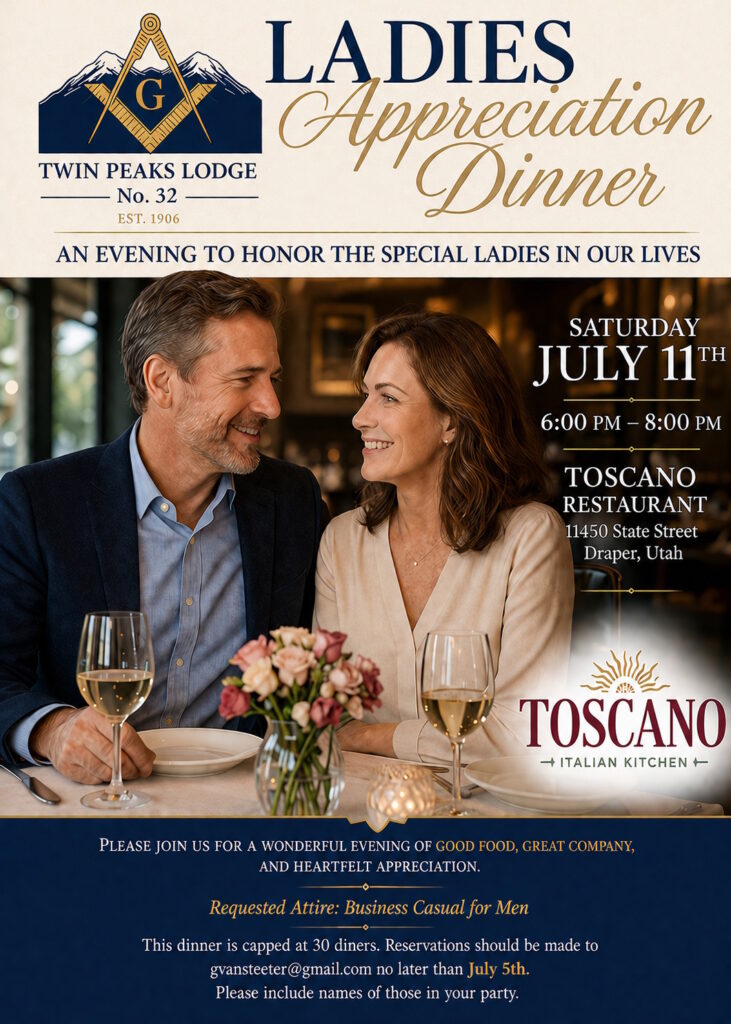
Speaking of our Lodge spouses, our annual Ladies Appreciation Dinner is fast approaching! It will be held at Toscano Italian Restaurant in Draper, Utah on July 11th from 6 to 8 pm. Please see the article later in this newsletter for more details. Two things to note. The seats are capped at 30, so make your RSVPs early. You will be ordering from a special menu. You can expect the cost of a meal to start at about $30.
Lastly, start thinking about summer bowling on Monday, August 10th, from 7 pm to 9 pm at the All-Star Bowling Lanes located at 1776 W 7800 South, West Jordan. Brother Carlos de Silva is the guy to beat as he was both the high game and high series bowler last year. Friends and family are cordially invited. I will provide more information in the August Trestleboard, but last year 2 hours of bowling per person (with food and sodas) was $29.99 per hour, so plan accordingly. I will start taking RSVPs late July.
As you head into your busy and fun Fourth of July weekend, we Utahns need to be mindful of the extreme drought that we find ourselves facing. Please, for this year, consider putting aside your private fireworks display and go to a professional display instead. The danger is just too high.
Finally, as your Trestleboard Editor, you will find some educational articles that are in context with our nation’s anniversary. Please take a look at them, digest them, and then think upon them. While we enjoy grilling, boating, camping and many other fun activities over the holiday, don’t forget to think about how fortunate we are to live in a country founded on the principle that all are equal before the law, and nobody is above the law. Yes, our system isn’t perfect. No such perfect system of government exists. Remember how precious our country is, and thank the Great Architect for the bounty that we enjoy.
Fraternally submitted,
Glen Van Steeter, PM – Junior Warden
Twin Peaks Lodge No. 32

Welcome our Newest Mason
On June 15th, Twin Peaks 32 initiated our newest Entered Apprentice, Brother Sergio Passerini, in the Moorish Room of the Salt Lake Masonic Temple. We are happy to have you in our Lodge and hope that your experience will be enjoyable and of great profit to yourself.
Calendar At A Glance
You can always find out what the Lodge is doing by going to the Calendar on our website. It is usually kept very up to date.
- Monday, July 6th @ 6:30 PM: Fellowship meal followed by the July Stated Meeting at 7:30 pm at the South Valley Masonic Center.
- Note: For suggested attire, Hawaiian Shirt or Polo Shirt and trousers (khakis).
- Saturday, July 11th @ 6:00 PM: Ladies Appreciation Night at Toscano’s in Draper. Please see announcement later in the Trestleboard for information on how to RSVP.
- Monday, July 13th @ 7:00 PM: Entered Apprentice Degree Practice at the South Valley Masonic Center.
- Thursday, July 16th @ 7:00 PM: Esoteric Education Night via Zoom. Link can be found on the Calendar page.
- Monday, July 20th @ 7:00 PM: Entered Apprentice Degree Practice OR Degree. The Calendar will be updated with information as soon as solidified.
- Monday, July 27th @ 7:00 PM: Social meetup at Chubby’s Cafe in Riverton, Utah.
JULY BIRTHDAYS
The following brethren were born in the month of July. HAPPY BIRTHDAY!
- Brother Rick Nils Hofmann was born on July 4.
- Brother Devin Foutz was born on July 12.
- Brother Christopher Ernest Rogers was born on July 12.
- Brother Bretton Leon Crockett was born on July 20.
- Brother Aflonso Dominguez was born on July 23.
- Brother Coleby O’Brien was born on July 28.
Brethren who were raised to the Degree of Master Mason in July
- Most Worshipful Brother Frank Charles Baker was Raised to the Sublime Degree of Master Mason on July 12, 1999 and has 27 years of service.
- Worshipful Brother Lyle Glenn Miller was Raised to the Sublime Degree of Master Mason on July 19, 2004 and has 22 years of service.
- Worshipful Brother Ephraim Y. Sng was Raised to the Sublime Degree of Master Mason on July 19, 2007 and has 19 years of service.
- Worshipful Brother Richard Lee Wailes was Raised to the Sublime Degree of Master Mason on July 19, 2004 and has 22 years of service.
- Brother Mark William Bisaillon was Raised to the Sublime Degree of Master Mason on July 28, 2003 and has 23 years of service.
Brother James Martin Receives 55 Year Award
On June 25th, Worshipful Master Frank Keller, accompanied by Worshipful Brother Bob Hartman and Brother Michael Martin, presented a 55 year certificate and pin to Brother James Guy Martin at his residence in Ogden, Utah. Brother James, and his wife, Jane, were very welcoming and we spoke at length about their travels in many foreign countries and on cruises since his retirement. Brother James, his wife Jane, and Brother Michael Martin (his son) were very appreciative and understanding of the great honor Worshipful Master Keller and the Lodge were presenting to Brother James.
It was a very good and pleasant experience to have been present at this event, honoring our 55 year member.
Brother James Guy Martin was initiated into Story Lodge #4 in Provo, Utah on November 17, 1966, passed to the degree of Fellowcraft on January 19, 1967, and raised to the Sublime Degree of Master Mason on March 16, 1967, He affiliated with Twin Peaks Lodge #32 on November 4, 2019 (after moving form Utah county to Salt Lake county) and demitted from Story Lodge #4 on December 5, 2019.
Although he has never held an office in either Lodge, he spoke quite warmly on the subject of the Masonic brotherhood, and how much he enjoyed being a member of the Fraternity.
Fraternally submitted,
Robert Hartman, PM
Bethel #16 Receives Awards at 2026 JDI Rally

Twin Peaks Lodge No. 32 congratulates the daughters of Bethel #16 of Sandy, Utah, for the awards that they received during the 2026 Summer Rally.
Ritual: 1st Place – Chaplain and Junior Princess
Other first place awards were for: Instrumental Music, Skit, Novelty, Girl’s Choice, Royalty Choice and the Grand Commander’s Trophy for Drill.
Well done and way to go, young ladies!
Ladies Appreciation Night – Saturday, July 11th from 6 to 8 pm.
MENU CHOICES
Entrees (Pick One)
- Chicken Parmesan (Breaded chicken breast, spaghetti, marinara, mozzarella, arugula, lemon, olive oil and cherry tomato)
- Fettucini Alfredo (Fettucini, Alfredo Sauce, mushroom, paremsan-regiano)
- Penne Bolognese (Penne, slow simmered beef & pork bolognese, permasan reggiano, basil)
Sides (Pick either a salad or soup)
- Salad
- House Italian (spring mix with cucumber, roasted tomatoe, castlevetrano olive, pepperoncini, balsamic vinaigrette, shaved parmesan)
- Chopped (romaine, pancetta, castlevetrano, olive, tomato, red onion, cucumber, pickled fennel, garlic & herb lemon vinaigrette)
- Ceasar (romain heart, courtons, shaved parmesan, caesar dressing)
- Tomato Basil Salad
There is a $250 fee for the Garden Room reservation, which we will divide equally between those who make reservations. Cost will be approximately $52 per meal, which includes beverages, an entree and one soup or salad. For 30 diners, this would be less than $10 per person. So, RSVP and let’s make it a BIG social event. RSVPs can be made to [email protected]. Please put “Ladies Night” in the subject line. Include your name, and the name of your spouse, along with your menu selections in the body of the email. All RSVPs must be made by early July 5th in order for me to give accurate numbers to the restaurant staff.
Reports of Events

Utah Food Bank June 20, 2026
Twin Peaks Lodge members, family and prospects had a wonderful day at the Utah Food Bank on June 20th! There were 9 Lodge members, 3 children of Lodge members, 3 spouses of Lodge members, 3 prospects and 1 member of Canyon Lodge present, a total of 19 volunteers. This week, for reasons we do not know, we did not have another group working with us, but that was ok, because Twin Peaks volunteers know how to work!
What did we do for the Utah Food Bank on Saturday, June 20th? Do you have any idea how much brown rice 19 eager, willing happy volunteers can re-package in 2 hours? I do. . .
One Ton, or 2000 Pounds
That’s right-each volunteer was responsible for packing 105 one-pound packages of brown rice!
The on-site coordinator we work with told the group that an average volunteer shift will package 900 pounds of rice.
Our next volunteer date is August 15th at 8 AM, and I will be asking for volunteers at the August business meeting. The dates and times for next year are in the Lodge calendar on our web page. Please note: for all volunteer dates from September 1 forward, the shift is shortened to 90 minutes, our time will be 8:30 to 10 AM. The volunteer coordinator at the Utah Food Bank, Angelina Remy, explained that some of the groups have been complaining a two hour shift is too hard, too much work.
Meeting on the Level at America’s 250th Year
On July 4, 2026, our nation will mark the 250th anniversary of the signing of the Declaration of Independence, a milestone that invites both gratitude and sober reflection. The men of that founding generation were not of one mind in every matter. They came from different colonies, different interests, different temperaments, and different visions of what liberty would require. Yet they understood that a nation could not be built by suspicion alone, nor preserved by endless division.
Among that generation were men whose names remain familiar to every American, including Masons such as Benjamin Franklin and John Hancock. Their example does not belong to one party, one faction, or one age. It belongs to the American inheritance itself: the belief that free men may disagree deeply and still meet one another with honor.
Freemasonry gives us a word for this: the Level.
To meet on the level is not to pretend that differences do not exist. It is not to soften conviction, surrender principle, or make every opinion equal in wisdom. Rather, it is to begin with the recognition that rank, wealth, office, and station do not make one man more worthy of being heard than another. In a time when public debate often rewards contempt, the level reminds us that dignity is not granted only to those who already agree with us.
Our nation today faces a familiar but serious challenge. In legislative halls, in public meetings, and around family tables, disagreement too often hardens into gridlock. Compromise is treated as weakness; restraint is mistaken for surrender; and the search for truth is replaced by the desire to prevail. Laws cannot be wisely formed when men refuse even to understand the concerns of their neighbors.
Here the old Masonic virtues still have work to do.
Brotherly love teaches that the man across from us is not first an obstacle, but a fellow citizen. Relief reminds us that political questions are rarely abstract to those who bear their consequences. Truth calls us to speak honestly, listen carefully, and resist the comfort of half-knowledge. Temperance restrains the tongue before anger gives it command. Prudence asks not only what can be won today, but what must endure tomorrow. Justice demands that we weigh not merely our own advantage, but the common good.
These are not campaign slogans. They are hallmarks of disciplined character. They do not tell a man what policy he must support, but they do shape the kind of man he ought to be while supporting it.
For Masons, this is not a matter of standing apart from the world and commenting upon it. Our Craft has always claimed to make good men better, and better men are needed most when public life grows coarse. We are called to be examples in the lodge, in the home, in the workplace, and in the community—not by speaking louder, but by speaking more honorably.
As America approaches its 250th year, perhaps one worthy tribute to the Founders is not merely to celebrate what they signed, but to recover something of the spirit required to sign it together.
The Level remains before us. Upon it, no man must abandon his convictions. But every man may remember how to meet his neighbor.
Fraternally Submitted by Brother Chris Van Steeter ~ Sr. Deacon of Twin Peaks Lodge No. 32
Freemasons of the Second Continental Congress
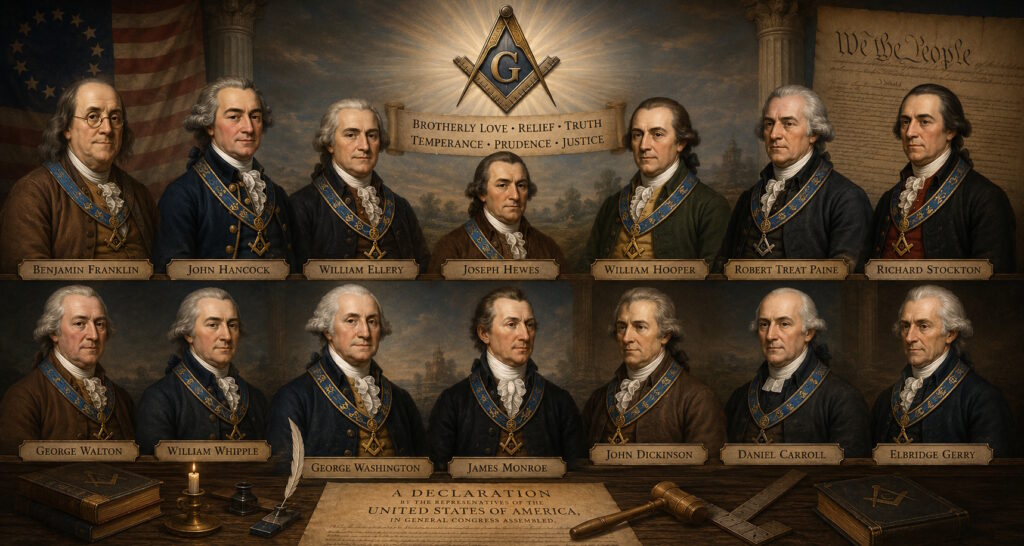
Here is a list of fourteen “Founders” of the United States, men of great learning and enlightenment who were not only pivotal figures in the founding of the United States, but also prominent Freemasons. Of these fourteen, five are questionable insofar as definitive membership roster records have not been found. However, of these five, contemporary stories as well as modern historical work would seem to imply that this is due to the fact that many records of Masonic Lodges were lost during the chaos of the era, and that they either were Masons, or they were closely associated with Masons.
The unifying characteristic of these fourteen men is their dedication to Divine Providence, their profound belief in the concept of Natural Law, and their conformity to the principles that defined “The Enlightenment”. As you read these very brief summaries below, try to discern how the Enlightenment and the principles of Freemasonry influenced their lives and actions.
Benjamin Franklin: St. John’s Lodge, Philadelphia, Pennsylvania. He was most likely initiated at the February 1730 -or-1731 meeting. He drafted By-Laws for St. John’s Lodge in June of 1732. On June 24th, 1734, he was elected the Most Worshipful Grand Master of Pennsylvania. While an ambassador to the court of France during the American Revolution, he affiliated with Loge des IX Soeurs, a Masonic Lodge chartered under the authority the Grand Orient de France.
He was one of the committee of five appointed by the 2nd Continental Congress to draft a “Declaration of Independence.” He was a true follower of the “Enlightenment”, known most famously for his experimentation with electricity. He was also the author and publisher of “Poor Richard’s Almanac”, and the inventor of the “Franklin Stove”, which design he made available at no cost for the general benefit of the people.
John Hancock: Merchants Lodge No. 277 of Quebec, Canda. He was initiated in 1760. He later affiliated with St. Andrew’s Lodge in Boston Massachussetts on October 14th, 1762, in which Lodge he was active throughout the Revolutionary Era. St. Andrew’s Lodge was a chartered Lodge of the Grand Lodge of Scotland. He was a Harvard graduate, earning a bachelor’s degree in 1754. In 1763, he became a partner in his uncle’s shipping business House of Hancock. A series of repressive acts and taxes laid upon Massachussetts by the United Kingdom resulted in Brother Hancock becoming a prominent political leader. While known today as a fervent patriot, his initial response to the Stamp Act of 1765 was to encourage loyal subjects to submit to the act though he believed Parliament was in the wrong. It didn’t take long for him to change his mind however, for in 1765 he participated in a boycott of British goods. This rocketed is popularity amongst Bostonians. He was unanimously elected President of the Continental Congress on May 24, 1775. His prominent signature on the Declaration of Independence has cemented him in popular culture as a leading figure of the Revolution.
William Ellery: St. John’s Lodge of Boston, Massachussetts, under the Grand Lodge of Massachussetts. He was initiated, passed and raised between October 12th and October 25th, 1748. He may have also been affiliated with St. John’s Lodge No. 4 of Hartford, Connecticut on February 8th, 1763.
He was active in the Rhode Island Sons of Liberty, and replaced statesman Samual Ward in 1776 in the Continental Congress. He was a signer of the Declaration of Independence, and although not much else is generally known about Brother Ellery in popular American culture, his signature is second only to John Hancock’s in size. He served as an associated justice of the Supreme Court of Rhode Island in 1780/81, and Chief Justice of the same court in 1785/86. He was a noted abolitionist.
Joseph Hewes: Brother Hewes was buried with Masonic Honors, and was registered as a guest/visitor at Unanimity Lodge No. 7 in Edenton, North Carolina on December 27th, 1776, however his home Lodge and exact membership dates are unknown. We therefore do not possess detailed Masonic records of his career.
Born in Princeton, New Jersey to Quaker parents, he gained much experience in trade and shipping before moving to Edenton, North Carolina, where he became a successful merchant and warehouse operator. Brother Hewes was elected to the North Carolina Provincial Assembly in 1766, later being sent to represent North Carolina in the Continental Congress in 1775. He initially hesitated to support the Lee Resolution for independence, but John Adams described when it came time for Hewes to cast his ballot, he ‘”‘started upright, and lifting both hands to Heaven, as if he had been in a trance, cried out, “It is done! I will abide by it.”‘
During the Revolution, his expertise in maritime affairs led to his appointment as Secretary of the Naval Affairs Committee, and he placed his own vessels in the service of the Continental armed forces. He also supported the appointment of John Paul Jones as a Naval Captain.
William Hooper: Hanover Lodge, Masonborough, North Carolina, chartered under the Grand Lodge of North Carolina. Colonial records appear to confirm his Masonic membership, but exact degree dates have been lost to time and the ravages of war.
Brother Hooper’s father desired that he should be an Episcopal priest, placing him in Boston Latin School for preparation. Brother Hooper graduated from Harvard with honors, obtaining a Bachelor of Arts degree. He then pursued a career in law who studied under James Otis, a prominent Boston attorney with a radical reputation. In 1764, Brother Hooper moved to North Carolina, and gained a high reputation by representing the colonial government in a number of court cases. He moved up the ranks, culiminating as the deputy Attorney General of North Carolina in 1770. Initially, Brother Hooper was a royalist, and in 1773, was elected to the General Assembly. However, he became sour on the British government which was attempting to influence the General Assembly to pass a series of laws that would regulate provincial courts.
He was appointed to the 1st Congress in 1774, and served in the 2nd Continental Congress. Because of his work in North Carolina, he missed the July 2nd vote to adopt the Declaration of Independence, but he was present on August 2nd, 1776 to sign it. He was a person of peculiar attention to the British Army, who attempted to capture him. They also burned his estates in Finian and Wilmington.
Robert Treat Paine: Signed the Declaration of Independence. Served in the 2nd Continental Congress from 1774 to 1778. He represented the Massachussetts Colony. He was one of the 1775 “Olive Branch Petition” signers, a final effort towards reconciliation with Great Britain. Paine only turned towards full support of the motion on independence after the British Crown fully rejected the reconciliation overture. During the War of Independence, he served as the Chairman of the Committee on Ordnance, in which role he took on the critical responsibility of standardizing arms and aggressively scaling up the domestic manufacture of gunpowder, muskets, and artillery.
He was known for being “overly” meticulous and argumentative, receiving the ire of fellow Massachussetts representative John Adams, who nicknamed him the “Objection Maker” due to his habit of questioning and challenging legislative proposals.
He is historically considered a Massachussetts Freemason affiliated with a Lodge of the same jurisdiction, and was notably present at the Grand Lodge of Massachussetts St. John’s Day on June 26th, 1759, but the dates of his Degrees are unknown, as well as the identify of any Lodges he actually was a member of.
Richard Stockton: St. John’s Lodge No.1 of Princeton, New Jersey, of the Grand Lodge of New Jersey. He was a Charter member and the first Worshipful Master of the Lodge starting December 27, 1764.
Worshipful Brother Stockton attended the College of New Jersey, graduating in 1748, and admitted to the bar in 1754. He was a friend of George Washington. He initially had no interest in politics, stating that the public “is generally unthankful”. He was a trustee of the College, which was evenutally renamed Princeton University for 26 years. In 1766 and 1767, he went on sabbatical in England, Scotland and Ireland, where he was warmly received. He had the honor of personally presenting to King George III an address of the trustees of the College. While in Scotland, he came into the acquaintance, and later friendship, of the Reverend John Witherspoon. Returning to New Jersey, he eventually was appointed to the provincial New Jersey Supreme Court.
Initally, his stance regarding building hostilities with Britain was quite moderate. In 1774, he sent a missive to Lord Dartmouth which was a plan of American self-government, independent of Pariliament but still under the Crown, or, in other words, a Commonwealth. George III did not accept this proposal. He was elected to the Second Continental Congress in 1776 and was very active. He was a signer of the Declaration of Independence. Worshipful Brother Stockton was captured by Loyalists while evacuating his family to safety. WB Stockton was offered a parol by General William Howe, which he eventually did, but was then placed in irons and kept in various locations under captivity until January 13, 1777, when he was again paroled. However, in 1777, all members of Congress and the Continental Army were required to take the oath of allegiance to the nascent United States, including WB Stockton, which violated his parole. He then resigned from Congress. During his incarceration, he fell deadly ill, eventually succcumbing on February 28, 1781, under a cloud of suspicion of disloyalty to the United States. However, on March 7th, 1781, the New Jersey Gazette acknowledged WB Stockton’s service to his country. WB Stockton was the only signer of the Declaration to be captured and imprisoned by the British.
George Walton: Solomon’s Lodge No. 1, F&AM of Savannah Georgia.
George Walton was one of the nine Masonic signers of the Declaration of Independence. He represented Georgia Colony. Although there does not appear to be any reference to official records that he ever achieved the post of Worshipful Master, it is generally accepted that his Masonic affiliation was deeply intertwined with his transformation from an impoverished carpenter’s apprentice into one of Georgia’s most esteemed legal and political figures. It is generally accepted that he relocated from Virginia to Savannah, Georgia around 1769, where he apprenticed to a local barrister (lawyer). While deeply involved in his legal studies, he still found time to pass off his catechisms in all Three Degrees before being admitted to the Georgia Bar, which occurred in 1774.
Solomon’s Lodge No. 1 of Savannah, Georgia has the distinction of being recognized as the oldest continuously operating English-constituted Masonic Lodge in the Western Hemisphere. At this time, Masonic Lodges were cradles and practitioners of the principles of the Englightenment, and much of Brother Walton’s personal philosophy was formed in this benevolent environment. Concepts such as universal brotherhood, personal character over inherited nobility, and duty to God closely mirrored the Enlightenment ideals that fueled his political position.
In May of 1791, President (and fellow Masonic brother) George Washington conducted his “Southern Tour”, which included a stop in Georgia. Brother Walton was given the honor of welcoming the President with an official Masonic Address.
Outside of Freemasonry, his service to the nascent United Colonies can be expressed as follows:
- He was appointed to the 2nd Continental Congress in early 1776 as a representative of the Colony of Georgia.
- He took a leave of absence from politics to serve as Colonel in the First Georgia Militia. He was shot from his hourse while defending Savannah from the British in 1778, and taken as a prisoner by the British, in which condition he remained for ten months before being repatriated in a prisoner exchange.
- Following the war, he served as the Governor of Georgia (1779, 1789), Chief Justice of the Supreme Court of Georgia (1783 – 1789), and filled a vacancy in the U.S. Senate from 1795 to 1796.
In honor of the service Brother Walton gave to Freemasonry and the United States, two Masonic Lodges have been named in his honor:
- Walton Lodge No. 200, Jasper County, Georgia
- George Walton Lodge No. 699, Augusta, Georgia
Joseph Hewes: Signed the Declaration of Independence. Served in the 2nd Continental Congress from 1775 to 1779. Consider the de facto first Secretary of the United States Navy, laying the foundations for its organization and notably promoting naval hero John Paul Jones. John Adams, later the 2nd President of the United States, credited Hewes with laying the “cornerstone of the American Navy.” He represented the colony of North Carolina.
He was officially recorded as a guest/visitor at Unanimity Lodge No. 7, in Edenton, North Carolina on December 27th, 1776. He was buried with Masonic Honors, but his home Lodge and exact membership dates are unknown.
Hewes was highly respected by his contemporaries, including French dignitaries and fellow Congress members. His dedication to the patriot cause ultimately took a toll on his health; he died while in service at Philadelphia on November 10, 1779, and is buried at the historic Christ Church Burial Ground.
William Whipple: William was a delagate from the colony of New Hampshire and a signer to the Declaration of Independence. He served from 1776 through 1779. He voted in favor of independence and officially signed the Declaration of Independence on August 2, 1776.
He held high-utility roles as a member of the Marine Committee, the Foreign Relations Committee, and the Quartermaster Committee. He personally delivered John Paul Jones his historic commission as captain of the USS Ranger.
His military service during the War of Independence included holding the rank of brigadier general at the Battle of Saratoga. Realizing the hypocrisy of fighting for liberty while holding another man in bondage, he freed his slave Prince Whipple.
He was initiated into St. John’s Lodge No. 1 in Portsmouth, New Hampshire, the longest continuously operating Masonic Lodge in New Hampshire, which was chartered in 1732. His initiation occurred in 1752. At this time, he was a successful shipmaster. 50 active brothers of St. John’s Lodge No. 1 served directly served in the American armed forces or on privateers during the conflict.
George Washington: The “Father of his Country”. 1st President of the United States. Member of the 2nd Continental Congress although he did not sign the Declaration of Independence. He was also the Commanding General of Colonial Armed Forces during the American War of Indpendence.
George Washington served with the British Army during the Seven Years War, also known as the French and Indian War. This service gave him valuable skills that he would later leverage as the Commander-in-Chief of the Colonial Army.
His Mother Lodge was Fredericksburg Lodge No. 4 in Fredericksburg, Virgina. He was initiated November 4, 1752, passed on March 3, 1753, and raised to Master Mason on August 4, 1753. Worshipful Brother George would then become an honorary member of Alexandria-Washington Lodge No. 22 in Alexandra, Virgina on June 24, 1784. He became its charter Worshipful Master and served from 1788 to 1789, concurrently while he was President of the United States. He later became an honorary member of Holland Lodge No. 8 in New York City. Although not regularly active in this Lodge, he had close ties with many New York masons. During his first presidential inauguration in 1789, he took his oath of office on the altar Bible borrowed from New York’s St. John’s Lodge No. 1.
John Dickinson: a wealthy lawyer, political theorist, and delegate from Pennsylvania to the 2nd Continental Congress who became known as the “Penman of the Revolution“. He championed Dickinson championed a cautious, constitutional path to redressing colonial grievances. He strongly opposed immediate separation from Britain, famously arguing against the Declaration of Independence on July 1, 1776, because he believed the colonies were militarily unprepared and lacked vital foreign alliances. He penned the famous “Olive Branch Petition” in 1775, a final attempt by the 2nd Congress to reconcile with King George III. He also helped draft the first framework of the Articles of Confederation in June 1776.
Dickinson was a Quaker with strongly held religious convictions, which informed his resistance to calls for independence from the Northern Colonies. When it ecame clear that the vote for independence would pass, Dickinson deliberately abstained from voting on July 2 and voluntarily absented himself from the signing to preserve congressional unity without violating his conscience. He was one of the few wealthy congressmen to immediately take up arms, serving on the front lines as a militia private, later commissioned a brigadier general.
Although his membership in the Lodge in Dover, Delaware is not backed by membership roster records, historians note that his political style and leadership, centered on building consensus, moral discipline, the rule of law, mirrored the Enlightenment philosphy shared by other Masonic Founding Fathers like Franklin and Washington.
Daniel Carroll: A a wealthy Maryland planter, politician, and one of only two Roman Catholics to sign the United States Constitution. He represented the Maryland Colony while serving in the 2nd Continental Congress, beginning his tenure in 1781, only two years before the War of Independence was concluded. He delivered Maryland’s official ratification of the Articles of Confederation, and being the final state to sign, his signature ratified the Articles of Confederation. However, before his signing of the Articles, he insisted that larger states like Virginia renounce their expansionist western land claims, ensuring frontier territories became public domain managed by the Central Government. He has the political distinction of being one of five men who signed both the Articles of Confederation and the United States Constitution. In 1791, he was chosen by his close friend George Washingto as one of three principal commissioners tasked to survey and design the new “Federal City”.
His Masonic membership may be conflated with that of his relative John Carroll, or listed on generic lists of constitutional masons. An examination of the records of the Grand Lodge of Maryland have failed to reveal any definitive evidence of his initiation or membership timeline. However, family lore and contemporary tales imply that he had a close relationship with many Maryland Masons. His membership would have also been in direct conflict with the Papal Bull of 1738 from Pope Clement XII, who banned all Catholics from Freemasonic membership. However, in the chaotic times of the 1750’s through the War of Independence, many Catholic Masons were open members of the Fraternity without local diocese action.
Elbridge Gerry: He was an influential Massachusetts merchant, signer of both the Declaration of Independence and the Articles of Confederation, and the fifth Vice President of the United States. While several fraternal records claim he was a Freemason affiliated with the Philanthropic Lodge in his hometown of Marblehead, historical Grand Lodge scholars consider his membership to be of “doubtful validity”, often noting he is frequently confused with his brother, John Gerry, who was a documented member of that exact lodge. Some of this confusion may arise from the belief that some of the Lodge’s official records have gone missing.
While serving the 2nd Continental Congress, he was noted for the following roles and actions. He used his extensive family Gerry utilized his extensive family merchant fleet to successfully smuggle arms, gunpowder, and food to the newly formed Continental Army during the Siege of Boston.
He took his seat in February 1776, where he aggressively lobbied hesitant middle-colony delegates to break from Britain. His fierce resolve prompted John Adams to famously declare, “If every Man here was a Gerry, the Liberties of America would be safe”.
He was also known as “The Soldier’s Friend”, due to He earned this lasting congressional nickname due to his strict, unyielding legislative focus on securing better pay, apparel, and proper field equipment for the enlisted continental troops.
Elbridge Gerry is a controversial figure for actions he took after the successful conclusion of the War for Indpendence. He was one of only three remaining delegates who actively refused to sign the final United States Constitution in 1787. He vehemently blocked it because it lacked an explicit Bill of Rights and granted excessive power to the executive branch. Later, while serving as the Governor of Massachussetts in 1812, he signed a highly controversial partisan redistricting bill. An eagle-eyed political cartoonist noted that one oddly shaped voting district perfectly resembled a salamander, permanently coining the term “Gerry-mander” in American political lore.
Using the craft to bring the temperature down
As I consider the suggested topics of our Junior Warden requesting articles for the July Trestleboard one thought keeps coming to mind… Subduing our passions. While we hear it often, how much do we consider it?
In today’s political climate voices keep getting louder and louder and it seems more and more to be centered around loyalty to one party or another. This is a time when subduing our passions is something the majority of America could use a lesson in. The question then becomes what does that look like? Well a few examples would be
- Evaluating claims based on evidence rather than whether they support your preferred political side.
- Avoiding personal attacks against people with different views
- Be willing to acknowledge when your side is mistaken
- Taking time to verify information before sharing it.
- Remaining civil during political discussions, even when the issues matter deeply to you.
None of this requires political neutrality, nor does it show a lack of conviction, you can hold strong political beliefs and still still strive to subdue your passions. The Idea is that your convictions should be guided by reason, principle, and facts rather than by uncontrolled emotion.
The greatest thinkers across the political spectrum have argued that self-government is a democracy requires a degree of self-governance by its citizens.
Remember my brothers, Speak and act from considered principles and evidence, not merely from emotional impulse or partisan loyalty.
Fraternally submitted,
Michael Hartman, Senior Warden
Masonic Brotherhood Between Enemies At Gettysburg
July 1-3, 1863.
Midway through the American Civil War, more than 50,000 men became casualties during the Battle of Gettysburg.
For three terrible days, Americans fought Americans.
Brother fought brother. Friend fought friend.
It remains, to this day, the bloodiest battle ever fought on American soil.
Yet, from that unimaginable tragedy comes one of Freemasonry’s most enduring stories.
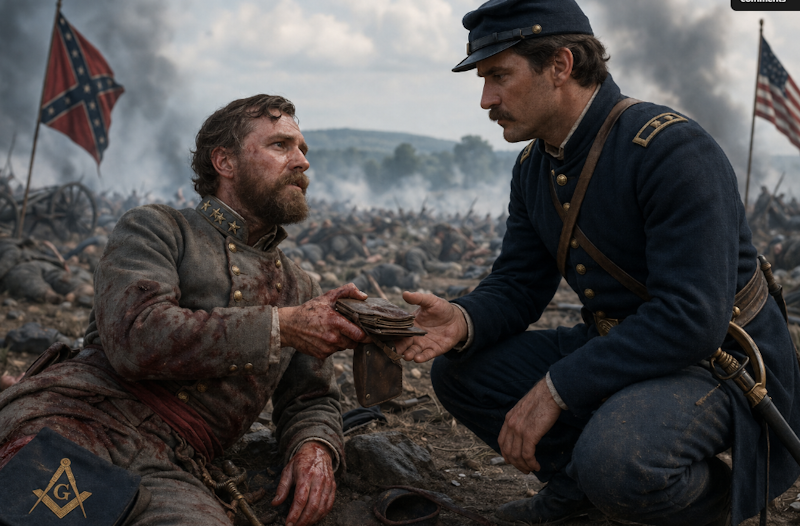
On July 3rd, during the infamous Pickett’s Charge, Confederate Brigadier General Lewis Armistead led his men to what would become known as the “High Water Mark of the Confederacy.” There he fell, mortally wounded.
Nearby was Union Captain Henry H. Bingham, himself wounded and serving on the staff of Union General Winfield Scott Hancock.
What happened next has become part of Masonic history.
Both Armistead and Bingham were Freemasons.
Knowing Bingham served under Hancock—a close personal friend from before the war—Armistead entrusted him with his watch, personal effects, and a final message to be delivered.
Historians continue to debate whether a Masonic sign or appeal played any role in their meeting.
What they do not debate is this:
A wounded Union officer stopped to help a dying Confederate officer.
One Brother showed compassion to another in the middle of one of history’s most violent battlefields.
More than 130 years later, the Friend to Friend Masonic Memorial was dedicated at Gettysburg to commemorate that moment—not as a celebration of war, but as a reminder that Brotherhood can survive even when nations cannot agree.
The inscription says it best:
“Their unique bonds of friendship enabled them to remain a brotherhood undivided, even as they fought in a divided nation.”
I think that’s why memorials matter.
They are not built to glorify conflict. They exist to remind future generations of the terrible price already paid… and the lessons we should never have to learn twice.
Today our world is still divided. Politics. Religion. Culture. Social media. Even within our own Lodges.
It’s easy to forget that the man sitting across the room from us is still our Brother.
Gettysburg reminds us that disagreement does not have to destroy respect. Difference does not have to destroy compassion. And Brotherhood is tested not when we agree…
…but when we don’t. Perhaps that’s the greatest lesson the Friend to Friend Memorial leaves us…
..not that two Masons met on a battlefield. But that humanity still found a place there. May we never need another battlefield to remember what our obligations already teach us.
Submitted by Michael E. Hartman, Sr. Warden, Twin Peaks Lodge No. 32
Attribution for the article was not provided.